5G Wi-Fi vs. 5G Cellular
There's a "5G" after the name of my Wi-Fi. Does that mean the network speed will be super fast? With the full popularization of 5G, many citizens have raised questions. In this regard, Zou Xing, a WiFi technology expert from China Mobile, stated that the "5G" in WiFi stands for 5G Hertz, representing the 5G frequency band, which is not the same as 5G in mobile phones.
There are two common working frequency bands for WiFi that we often see: 2.4G and 5G. The 5G of mobile phones refers to the fifth generation of communication technology, which is not the same as the 5G of WiFi.
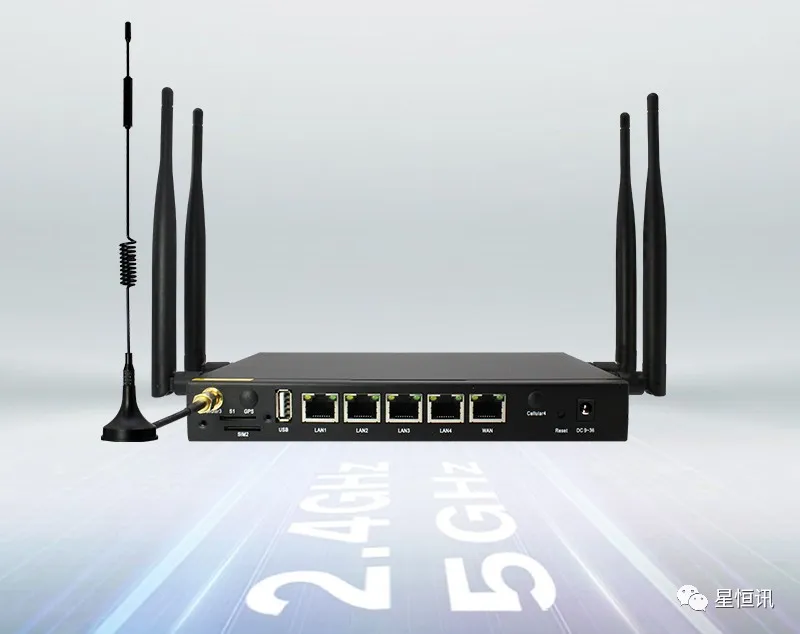
Router 5G WiFi
Why is there a "2.4G" and a "5G" after the name of WiFi? In the past, routers only had 2.4G WiFi signals on one frequency band, which was very limited. Many devices operated on the 2.4G frequency band, but the interference between signals was significant and the speed was not very fast. With the popularization of fiber-optic broadband, many new routers are dual-band wireless routers that simultaneously transmit WiFi signals in both 2.4G and 5G frequency bands.
2.4G WiFi signals have a low frequency and a long wavelength, resulting in less attenuation during propagation. They are more likely to pass through obstacles and have a longer propagation distance. However, the 2.4G bandwidth is relatively narrow, with more interference and prone to congestion. The maximum speed of 2.4G WiFi can reach 10M/S.
In contrast, 5G WiFi has a wider bandwidth, less interference, and is both fast and stable. The newly developed frequency band is like driving to a new urban area, with fewer cars, wider roads, and faster speed. However, it has poor wall-penetrating ability and a short transmission distance. The maximum speed of 5G WiFi can reach 60 meters per second.
So, if it is close to the router, we should give priority to using 5G WiFi signals, as the network speed will be faster. On the contrary, if you are far from the router, you will find that the 2.4G WiFi signal is better, while the 5G WiFi signal is almost impossible to connect to.
Network characteristics
1. The peak rate needs to reach the standard of Gbit/s to meet the transmission requirements of large data volumes such as high-definition video and virtual reality.
2. The latency level of the air interface needs to be around 1ms to meet the requirements of real-time applications such as autonomous driving and telemedicine.
3. Super large network capacity, providing the connection capability for hundreds of billions of devices, meeting the communication requirements of the Internet of Things.
The spectral efficiency is more than ten times higher than that of LTE.
Under continuous wide-area coverage and high mobility, the user experience rate reaches 100Mbit/s.
6. The flow density and connection number density have been significantly increased.
7. The system's level of coordination and intelligence has been enhanced, which is reflected in the collaborative networking of multiple users, multiple points, multiple antennas, and multiple receivers, as well as the flexible and automatic adjustment between networks.
At present, most of the new models launched by mobile phone manufacturers support 5G networks. 5G network communication has been widely deployed in first-tier cities, while it has not yet been popularized in third - and fourth-tier cities and towns.
So, it will take another two or three years for 5G networks to be truly popularized.